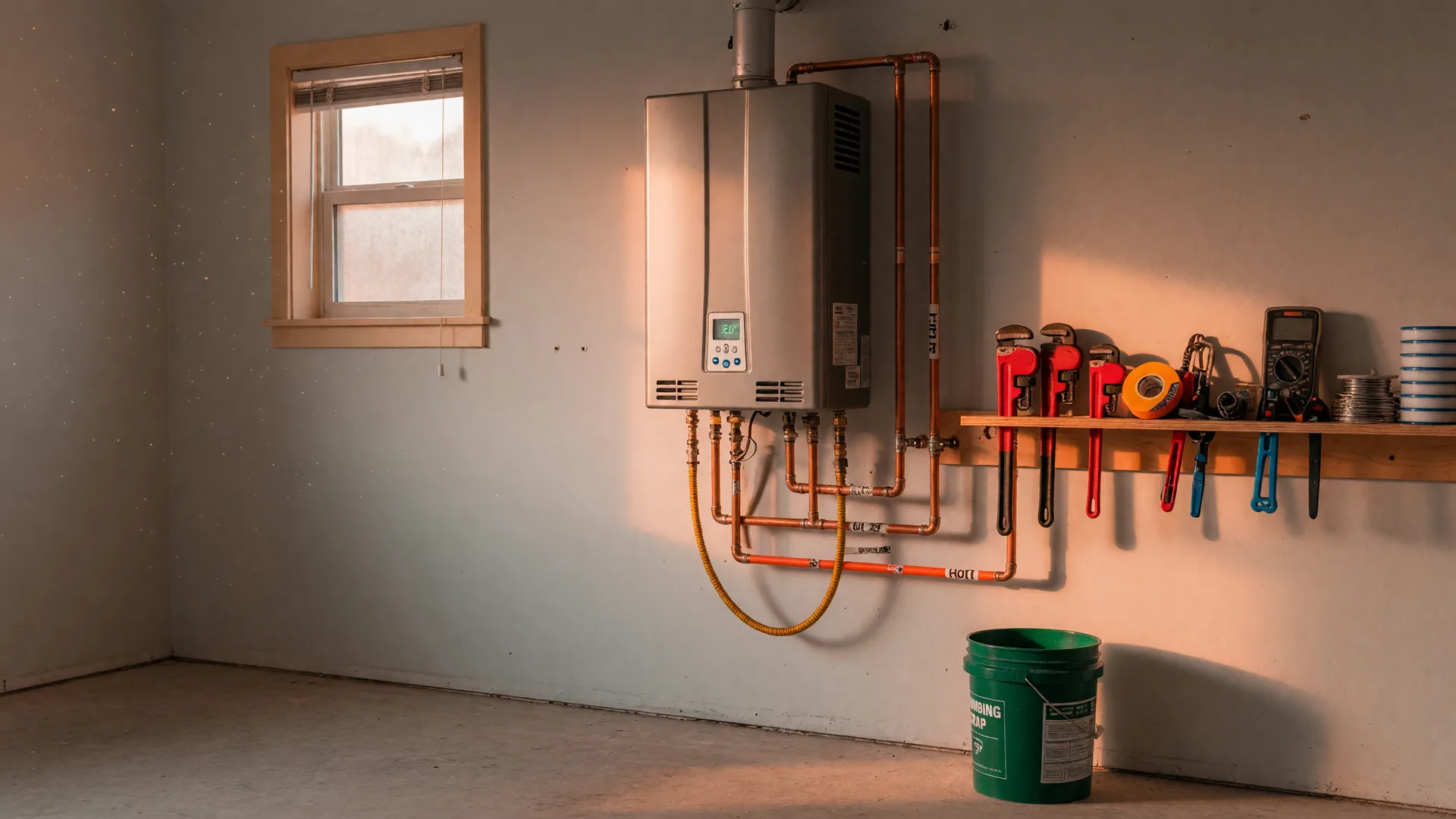
A water heater question we hear more each year
As the weather cools across San Diego County and hot water gets more attention, we are asked the same thing more and more: should I replace my tank water heater with a tankless one? It is a fair question, and the honest answer is that it depends on your home. This is how we talk it through with neighbors in Chula Vista, La Mesa, El Cajon, Santee, and the rest of the county.
The two types simply work differently. A tank water heater keeps a full tank of water hot around the clock, so hot water is ready the instant you turn on the tap, but the heater keeps firing to hold that temperature even when nobody is using water. A tankless unit heats water only when you need it, which is why it is more efficient and why it does not run out of hot water halfway through a shower.
The honest lifespan and efficiency math
Tankless water heaters are built to last. ENERGY STAR cites a life expectancy of about 20 years for tankless units, while a conventional tank typically lasts roughly 8 to 12 years. Because a tankless heater only fires up when you call for hot water, it also avoids standby loss, the energy a tank burns just to keep water warm. For a household that uses hot water efficiently, that difference adds up over the life of the unit.
The tradeoffs are real too: a tankless unit costs more up front, and it needs a little more attention in a hard-water area like ours. If your home is not ready for one, we will tell you honestly, and we will tell you when a tank still makes more sense for your family.
What San Diego's hard water does to each type
San Diego water is hard, averaging about 16 grains per gallon in city water, and that matters for both kinds of heater. In a tank unit, dissolved minerals settle at the bottom as sediment, which is why an annual flush keeps a tank efficient and protects its anode rod. In a tankless unit, the same minerals can build up as scale on the heat exchanger, the part that does the actual heating.
The fix for a tankless is regular descaling, circulating a vinegar or descaling solution through the unit. In a hard-water area, manufacturers generally recommend descaling about once a year, and more often in very hard water. It is a maintenance habit, not a dealbreaker, but it is part of the honest difference between the two.
- Tank: flush the tank once a year and have the anode rod checked to protect it from corrosion
- Tankless: descale about once a year so scale does not build up on the heat exchanger, more often in very hard water
- A water softener cuts down on how often either type needs this care
Which one fits your home?
If your family uses a lot of hot water at once, showers back to back in the morning, a properly sized tankless unit with enough gas supply handles it without running out. If your hot water use is modest and you want the simplest, lowest-cost option, a tank may be the right call. We size the unit to your home and your habits, and we tell you the truth about what your current plumbing can support.
Going tankless can also mean real work beyond swapping the unit: a bigger gas line, new venting, or an electrical upgrade. That is exactly the kind of job we do as part of a water heater installation or a whole-home repipe, and it is exactly why we quote the full picture up front.
We will help you choose, and price it up front
You should never have to guess which water heater fits your home. If your current unit is getting older, or you are tired of running out of hot water, call 619-600-3776 or request a quote. We will look at your current setup, explain the options in plain terms, and agree the price before any work begins. Same family, same standard: done right, the first time.
Need a hand with any of this?
The family that does the work is one call away.
Drain cleaning, hydro jetting, sewer line repair and replacement, slab leak repair, whole-home repiping, leak repair, and water heater service and installation across San Diego County. Mention the $40 in-home drain special and we will work it into your quote, camera inspection included.